April 2026 — Aurora Alert, Skywatching Tips & News from Around the Universe
Hello all stargazers! Welcome to spring. Here's this month's skywatching tips, our upcoming event schedule, and news from around the universe.
Aurora Alert
Strong G3-class geomagnetic storms are possible later today, March 31st, when a CME is expected to graze Earth. It was launched by yesterday's X1.5-class solar flare. NOAA and NASA models disagree on the timing and severity of the impact, so there is uncertainty in the forecast.
If the CME arrives on time, NASA's Artemis II Moon rocket could launch into a geomagnetic storm on April 1st. Despite the potential for "strong" storming, this space weather event is far from extreme and should not endanger the mission. (spaceweather.com)
What's up in the April sky?
This month we say goodnight to Orion and welcome the rise of Cygnus the Swan, Hercules, Lyra, and the bright band of the Milky Way, which climbs from the horizon to high overhead by late summer. Jupiter remains visible until about the second week of June, while Mercury makes a brief appearance in the early-morning sky. See NASA/JPL's tips.
What's Up: April 2026 Skywatching Tips from NASA →
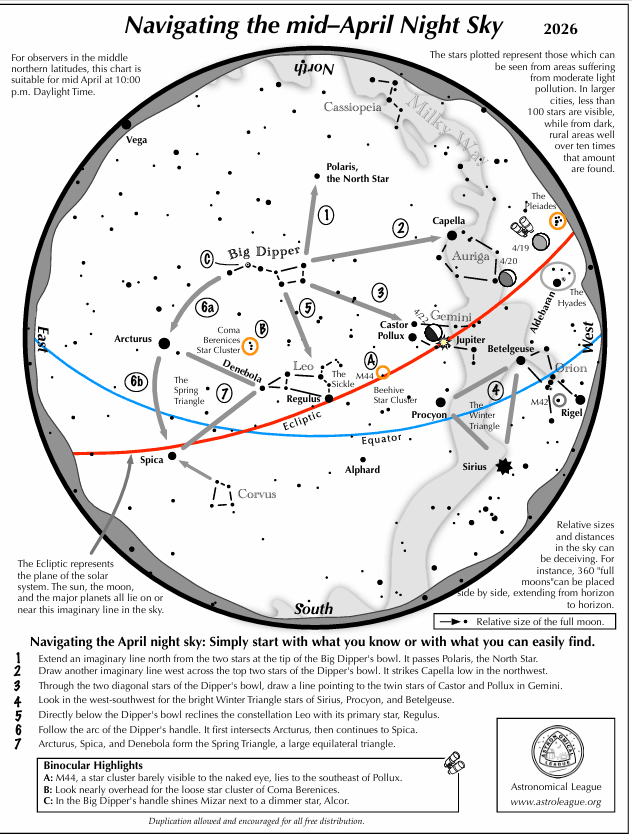
Navigating the mid-April sky using the Big Dipper
April sky map
Upcoming events
- May 4 · 11:00 AM — Colonizing the Moon: A First Step to Mars — Minocqua Public Library. Bob Krueger walks through Artemis, lunar science, and what's next on the way to Mars. Free.
- May 15 · 5–7 PM — Are We Alone in the Universe? — Nicolet College. NASA's search for life beyond Earth, plus Frank Drake's famous equation. $25 class fee.
- June 21 · 1–4 PM — Summer Solstice Solar Observing — Torpy Park, Minocqua. The Sun remains very active; with good weather we might see large prominences. Free.
- June 24 · 9:30 AM — Kids Space and Astronomy Camp — Northwoods YMCA, Rhinelander (unconfirmed). Rocket balloons, UV beads, moon phases, solar-system scale, meteorites. Volunteers welcome.
- July 14 · 1:00 PM — Kids Space and Astronomy Camp — Minocqua Library. Same hands-on lineup as Rhinelander. Volunteers welcome.
- Aug 12 · 7:30 PM arrive / 8 PM program / 8:45 observing — Perseid Meteor Watch with Oneida and Vilas Counties' Lights-Out Program at Nicolet College. Free. Volunteers welcome.
- Aug 15–16 · 1–4 PM — Vilas County Fair Solar Observing. Volunteers welcome.
- Aug 17 (multi-day) — Camp American Legion Lake Tomahawk Stargazing — stay tuned.
Smart telescope at the Minocqua Library
NESA has donated a ZWO Seestar S50 smart telescope to the Minocqua Public Library. It will soon be available to check out. It's best for imaging nebulae and other deep sky objects — controlled by a smartphone or tablet, like most modern smart telescopes.
News from around the universe
Artemis II launches tomorrow
NASA's Artemis II mission is set to launch tomorrow, opening a two-hour window at 6:24 PM EDT for the first crewed trip around the Moon in more than 50 years. Four astronauts will ride the Space Launch System rocket on a 10-day journey that tests Orion's life-support systems and paves the way for future lunar landings. Weather looks favorable, with an 80% chance of acceptable conditions, and backup opportunities run through April 6.
Lunar eclipse reveals hot spots on the Moon
Of the millions of people who witnessed the recent total eclipse of the Moon, amateur astronomer "Wah" in Canada saw a lunar disk like no other.
I used a thermal camera to observe the eclipse. The difference was amazing!
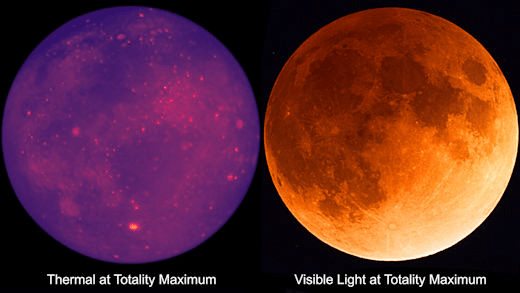
Wah's image was recorded at a wavelength of about 12 microns, where the Moon shines by its own heat rather than reflected sunlight. His setup included a 640×512 thermal camera and a 12-inch Newtonian telescope.
During a lunar eclipse, the full Moon cools rapidly. Normally its surface bakes after two weeks of sunlight, but once Earth's shadow cuts off the heat, different terrains cool at different rates. Fine dust chills quickly, while young, blocky craters stay warm and glow as hot spots.
Photos like this aren't just novelties. When properly calibrated, they can measure the thermal inertia of lunar regolith and map different rock types in potential landing zones. With NASA aiming to return to the Moon, this kind of information could be as golden as a total eclipse. (Spaceweather.com, March 5)
SpaceX plan for 1 million orbiting AI data centers could ruin astronomy
SpaceX has proposed launching one million AI-processing data-center satellites into orbit, but astronomers warn the project could severely damage ground-based astronomy. Unlike Starlink satellites — which dim as they rise and spend much of the night in Earth's shadow — these new data-center satellites would be large (up to 330 ft), bright, and fully sunlit even at midnight, creating tens of thousands of star-like streaks across the sky at any given time.
Astronomers say this would overwhelm telescopes such as the Vera Rubin Observatory and the Extremely Large Telescope, forcing shutters to close so often that observations would become unusable. They also warn of environmental impacts: with constant upgrades, one satellite could burn up in the atmosphere every three minutes, releasing aluminum oxide and other pollutants that may affect the ozone layer and upper-atmosphere temperatures.
Scientists are additionally concerned that the FCC fast-tracked the application, meaning SpaceX is not required to perform a full environmental review. Instead, astronomers must prove the project's harm on their own, under tight deadlines. (Tereza Pultarova)
The mystery of Ohio and Texas fireballs
Is Earth under siege? If you've been reading headlines about space rocks falling over Ohio, Texas, and other states, you might be wondering what's going on. According to NASA, it's nothing unusual — yet still a little mysterious.
Spring is fireball season. For reasons we don't fully understand, the rate of very bright meteors climbs 10% to 30% during weeks around the vernal equinox. — Bill Cooke, NASA Meteoroid Environment Office
The Ohio and Texas meteors landed squarely in the middle of the season. Onlookers saw the Ohio fireball on March 17th — only 3 days before the equinox. The Texas fireball appeared one day after the equinox on March 21st. Both were visible in broad daylight, with sonic booms and meteorites. One fragment reportedly punched through the roof of a home in suburban Houston.
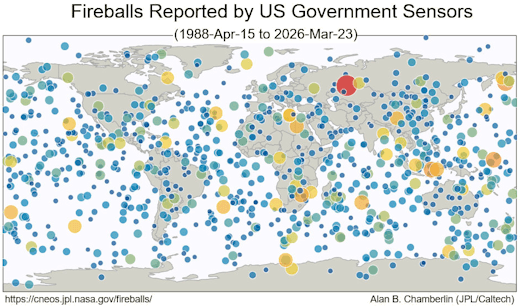
Although researchers have known about the spring surge for 30+ years, no one is sure what causes it. There seems to be an intrinsic variation in the meteoroid population along Earth's orbit, with a roughly February-to-June peak in large, fireball-producing debris. The source of the extra debris is unknown.
The two fireballs had completely different orbits. Plus, the meteorites they produced are quite different. Ohio finds are probably eucrites, whereas the recovered Texas meteorite appears to be an ordinary chondrite.
So, nothing unusual — but still a little mysterious. Keep looking up!
The Sun escaped the galactic center with thousands of "stellar twins"
Researchers analyzing ultra-precise Gaia data have discovered that our Sun was part of a mass migration of Sun-like stars that moved outward from the Milky Way's center 4–6 billion years ago. By building the largest-ever catalog of 6,594 "solar twins" — stars nearly identical to the Sun in temperature, gravity, and composition — scientists found a strong age peak showing that many of these stars formed together near the galactic core and later drifted outward as a group.
This finding helps solve a long-standing puzzle: the Milky Way's central bar structure creates a "corotation barrier" that normally prevents stars from escaping the inner galaxy. The new data suggests the bar was still forming when this migration occurred, allowing the Sun and its siblings to move outward before the barrier fully developed.
The study also highlights why this migration mattered: the galactic center is a harsh environment for life, while the Sun's current location is far more stable and hospitable. (Tokyo Metropolitan University)
Einstein Ring captured by JWST
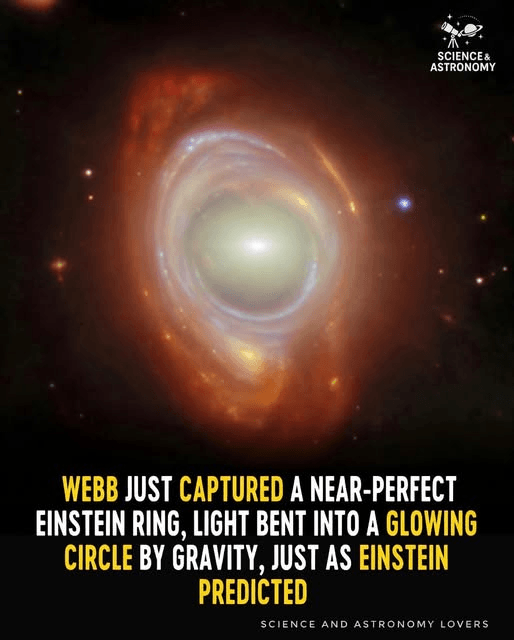
The James Webb Space Telescope has captured an extraordinary celestial masterpiece — a nearly perfect Einstein Ring shining across the depths of space. This striking circle of light is created when a massive galaxy acts as a gravitational lens, bending and magnifying the glow from a much more distant galaxy billions of light-years away. Perfect alignment between the galaxies and Earth transforms that light into a radiant loop — a phenomenon first predicted by Einstein nearly 90 years ago.
Thanks to JWST's incredible infrared vision, we can now see this ring in unmatched detail, revealing the hidden shape and structure of a galaxy from the early universe beautifully warped by the very fabric of spacetime.
Credit: NASA / ESA / CSA — James Webb Space Telescope
That's it for this month — keep looking up! Volunteers welcome.
Clear skies!